

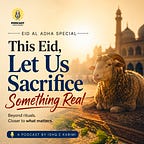

Ya Ali Madad.
Dear brothers and sisters... dear seekers of the Divine Light...
Welcome.
Welcome to Ishq e Karimi.
Before we say another word...
Let us pause for just a moment.
Let us close our eyes — even for a second.
And ask ourselves...
When was the last time we gave something up — truly gave something up — not because we had to...
...but purely out of love?
That question, my dear friends, is the very heartbeat of what we are about to explore together today.
Because on the twenty-seventh of May, twenty twenty-six — Muslims and Ismailis across the world will come together to observe one of the most profound, most moving, most spiritually charged moments in the entire Islamic calendar.
Eid ul Adha.
The Festival of Sacrifice.
The Festival of Devotion.
The Festival of Love so absolute...
...it asks everything of us.
And today — together — we are going to journey into the very soul of this blessed occasion.
We will walk through the desert sands of history.
We will stand at the foot of a mountain in Mina.
We will feel the trembling hand of a father.
And we will reflect — through the lens of our beautiful Ismaili tradition — on what Eid ul Adha is truly asking us to sacrifice.
Stay with us.
Because this is a story that will change the way we see this Eid — forever.
Let us go back.
Way back.
Back to a time before cities, before maps, before the world as we know it.
To a man who walked the earth with nothing but faith in his heart — and the Name of God on his lips.
His name was Hazrat Ibrahim — peace be upon him.
Hazrat Ibrahim, peace be upon him, was not born into comfort. He was tested from the very beginning. Thrown into fire by his own people. Exiled from his homeland. Separated from those he loved. And through every trial, every hardship, every dark night of the soul...
...he never wavered. He never doubted. He simply said:
My Lord. I am here. Command me.
And God, in His infinite wisdom, gave this man a gift — a son — late in his life, when hope itself seemed to have grown old.
His name was Hazrat Ismail — peace be upon him.
Can we imagine?
Can we imagine the love Hazrat Ibrahim, peace be upon him, must have felt for this child? The years of longing... the prayers whispered in the darkness... and finally — finally — a son.
A boy who laughed... who ran... who grew... who carried his father’s eyes and his father’s faith.
And then...
...came the dream.
In the stillness of the night, Hazrat Ibrahim, peace be upon him, received a divine command. Not once. Not twice. But three nights in a row — the same vision descended upon him like a truth that cannot be unseen.
O Ibrahim — sacrifice your son.
Let us sit with that for a moment.
That silence.
That weight.
That impossible moment.
This was not something any human heart could easily receive. This was the most beloved thing Hazrat Ibrahim, peace be upon him, possessed — and the Divine was asking him to let it go.
But here is what makes Hazrat Ibrahim, peace be upon him, the Khalilullah...
...the Friend of God.
He did not run from the command.
He did not bargain.
He did not pretend he had not seen what he had seen.
Instead, he went to his son — his young, brilliant, faithful son — and he told him the truth.
He said:
O my son... I have seen in a dream that I must sacrifice you. What do you think?
And Hazrat Ismail, peace be upon him — this remarkable young soul, this prince of faith — replied with words that have echoed through eternity:
O my father... do as you are commanded. You will find me, if God wills, among the patient ones.
Subhan Allah.
Let us pause here and truly feel this.
Father and son — walking together, toward an altar of love, hand in hand.
They were not walking toward death.
They were walking toward complete surrender to the Divine Will.
And when Hazrat Ibrahim, peace be upon him, laid his son down... when he turned the blade...
God called out:
O Ibrahim — you have fulfilled the vision. Indeed, this is the clear trial.
And in place of Hazrat Ismail, peace be upon him — a magnificent ram was provided.
The sacrifice had already happened.
Not in the physical act —
— but in the moment Hazrat Ibrahim, peace be upon him, chose the Divine... over everything else.
That moment of complete surrender —
— that is Eid ul Adha.
Now, dear friends —
This is where our beautiful Ismaili tradition invites us to go deeper — together.
In Ismailism, we are always asked to look beyond the zahir — the outer — and seek the batin — the inner, the hidden, the luminous reality beneath the surface.
Our tradition, rooted in the light of the Imamat, teaches us that every physical act in religion carries a spiritual meaning. Every pillar has a soul. Every rite has a ta’wil — an interpretation — that speaks directly to the transformation of the human heart.
So what is the batin of Eid ul Adha?
What is it that we are truly being asked to sacrifice — within ourselves?
Let us reflect together.
First —
The sacrifice of the ego.
In our tradition, the ram that is sacrificed is understood symbolically as the nafs al-ammara — the commanding lower self. That part within us that pulls us toward greed, arrogance, selfishness, and heedlessness.
The knife is the aql — the divine intellect, the light of reason that the Imam of the Time nourishes within us.
And so on this day, we are gently invited to look inward and ask ourselves —
What ego are we willing to let go of today?
What attachment is standing between us and the Divine?
Second —
The sacrifice of worldly attachment.
Hazrat Ibrahim, peace be upon him, was asked to give up the thing he loved most. And here, the Ismaili understanding is exquisitely beautiful.
Our Imams — may Allah grant them long life — have consistently guided us that the greatest veil between the mumin — the faithful — and the Divine Light is not hatred, not disbelief —
— it is excessive love of the dunya.
Excessive attachment to wealth, to status, to comfort, to the things of this world that we have mistaken for permanence.
Eid ul Adha whispers to us — gently, lovingly —
Are we willing to loosen our grip?
Not necessarily on things —
— but on the idea that those things define us.
Third —
The sacrifice of the self in service to the Imam of the Time.
In Ismaili theology, the relationship between the mumin and the Imam is not merely one of follower and leader. It is the relationship of the seeker and the Light. Of the beloved and the source of all love.
Hazrat Ali — peace be upon him — once shared that the highest form of worship is to surrender the will entirely to the Hujjat of God — the living proof of the Divine on earth.
Hazrat Ibrahim’s, peace be upon him, surrender to the Divine command was, in its deepest essence, the surrender of a murid to the Pir.
It was the surrender of a lover to the Beloved.
And this, dear seekers, is the profound spiritual invitation of Eid ul Adha for all of us as Ismailis —
Can we love the Imam of the Time the way Hazrat Ibrahim, peace be upon him, loved God?
Can we trust the guidance we are given — even when the world around us questions it?
That is the real qurbani.
The real sacrifice.
And Eid ul Adha, of course, is not only about inner spiritual sacrifice.
It is also about us — our community, our togetherness, our shared humanity.
About making sure that no one around us is hungry or forgotten.
The tradition of distributing the meat of the sacrifice into three parts — one for ourselves, one for our family and neighbors, and one for those in need — is a beautiful, living expression of what our faith calls us toward.
Our beloved Imam of the time, Mawlana Hazar Imam — may Allah grant him long life and health — has throughout his Imamat emphasized the dignity of every human being. His work through the Aga Khan Development Network reaches the most vulnerable corners of the world — providing food, education, health, and hope.
This Eid ul Adha, let us carry that spirit in our own small ways.
Let us give generously.
Let us reach out to a neighbor.
Let us remember those who have less.
Because the truest form of sacrifice...
...is when our giving costs us something —
— and we give anyway, with love.
As we approach the twenty-seventh of May, twenty twenty-six...
Let us sit together with a quiet reflection.
Eid ul Adha does not ask us to physically sacrifice everything we love.
But it does ask us to sit still...
...and look honestly at our lives.
And ask ourselves —
Is there something we are clinging to — fear, ego, resentment, an old wound — that is standing between us and the version of ourselves the Imam sees when he looks at us?
Is there someone we have not forgiven?
Is there a generosity we have withheld?
Is there a prayer we keep postponing?
This Eid —
Let that be our qurbani.
Let us place it on the altar of our intention.
And with the name of Allah —
— let it go.
Because the Divine did not take Hazrat Ismail’s, peace be upon him, life.
What the Divine took was Hazrat Ibrahim’s, peace be upon him, attachment to it.
And what the Divine gave back —
— was freedom.
Was peace.
Was the most profound nearness.
That nearness —
— that qurb —
— is what this day is truly about.
As we prepare to celebrate Eid ul Adha on the twenty-seventh of May, twenty twenty-six...
May our hearts be filled with the light of Hazrat Ibrahim’s, peace be upon him, faith...
...the patience of Hazrat Ismail’s, peace be upon him, surrender...
...and the love that our beloved Imam kindles within all of us.
May this Eid bring peace to our homes...
...healing to our hearts...
...and blessings upon every soul that is dear to us.
May Allah accept our ibadaat, our du’as, and the quiet sacrifices we make every day — that no one sees... but Him.
Eid Mubarak.
Ya Ali Madad.
And before we close —
If this reflection touched our hearts even a little... if it gave us one moment of stillness, one spark of meaning...
Then let us do something small that costs us nothing, but carries so much —
Let us share this with a friend, a family member, someone who might need these words today. We never know whose heart is quietly searching for exactly what we are about to pass along.
Let us subscribe to Ishq e Karimi — because every week, we sit together in reflection, in story, and in the spiritual insights of our beautiful Ismaili tradition. This is a community of seekers — and there is a place here for all of us.
And let us visit ishqekarimi.com — for articles, resources, and deeper explorations of our faith.
We are not alone on this path.
We walk it together.
Ya Ali Madad.
Frequently Asked Questions
What is Eid ul Adha and why is it observed?
Eid ul Adha — the Festival of Sacrifice — is one of the most sacred occasions in the Islamic calendar. It commemorates the extraordinary moment when Hazrat Ibrahim, peace be upon him, demonstrated complete surrender to the Divine Will by offering to sacrifice his beloved son, Hazrat Ismail, peace be upon him. Before the act was completed, Allah replaced Hazrat Ismail, peace be upon him, with a ram — signifying that the true sacrifice had already taken place in the heart of Hazrat Ibrahim, peace be upon him. It is observed on the 10th of Dhul Hijja and this year falls on the 28th of May 2026.
Why did Allah ask Hazrat Ibrahim, peace be upon him, to sacrifice his son?
This was not a command born of cruelty — it was the highest test of love. Allah, in His infinite wisdom, wanted to reveal to the world what true surrender looks like. Hazrat Ibrahim, peace be upon him, had spent his entire life being tested — thrown into fire, exiled, separated from loved ones — and through every trial he chose the Divine over everything else. The command to sacrifice Hazrat Ismail, peace be upon him, was the ultimate mirror held up to his soul. And in that moment of total surrender, Hazrat Ibrahim, peace be upon him, earned the title that echoes through eternity — Khalilullah — the Friend of God.
What was the response of Hazrat Ismail, peace be upon him, when his father told him about the dream?
This is one of the most moving moments in all of sacred history. Hazrat Ibrahim, peace be upon him, did not act in secret — he went to his son and told him the truth. And Hazrat Ismail, peace be upon him, this young, luminous soul, responded with words that have never stopped echoing: “O my father, do as you are commanded. You will find me, if God wills, among the patient ones.” He did not resist. He did not weep in protest. He walked hand in hand with his father toward the altar of love. That response is itself the definition of a mumin — a true believer.
What is the deeper spiritual meaning of the sacrifice in Ismailism?
In our Ismaili tradition, every outward act carries an inward meaning — this is the beauty of ta’wil, the esoteric interpretation. The sacrifice of Eid ul Adha is not simply remembered as a historical event. It is understood as a living, breathing invitation to every mumin. The ram symbolises the nafs al-ammara — the lower commanding self that drives us toward ego, greed, and heedlessness. The knife symbolises the aql — the divine intellect — that the Imam of the Time nourishes within us. The act of sacrifice is therefore the act of using divine reason to overcome the lower self. This is the real qurbani.
What is the nafs al-ammara and how does it relate to Eid ul Adha?
The nafs al-ammara, referenced in the Holy Quran, is the aspect of the human soul that commands toward base desires — arrogance, greed, attachment, and selfishness. It is the inner obstacle on the path toward the Divine. In the Ismaili esoteric understanding, Eid ul Adha asks us to look honestly at where our nafs al-ammara has taken hold — where fear, ego, or worldly attachment has created a veil between us and the Light of the Imam. The festival is therefore a deeply personal invitation to spiritual housekeeping — to identify what within us needs to be surrendered.
What is ta’wil and why is it central to the Ismaili understanding of Eid ul Adha?
Ta’wil is the Ismaili practice of esoteric interpretation — seeking the hidden, inner meaning of religious acts, texts, and symbols. Our tradition teaches that every zahir, every outward form, carries a batin — an inner reality. Without ta’wil, religion remains only ritual. With ta’wil, every act of worship becomes a doorway into transformation. Applied to Eid ul Adha, ta’wil reveals that the sacrifice is not primarily about an animal — it is about the surrender of everything within us that is not aligned with the Divine. This is what makes the Ismaili understanding of this blessed day so uniquely profound and personally challenging.
What is the connection between Hazrat Ibrahim, peace be upon him, and the Imam of the Time in Ismaili thought?
In Ismaili theology, Hazrat Ibrahim, peace be upon him, is revered not only as a Prophet but as one of the greatest examples of the relationship between the seeker and the Divine Guide. His complete surrender to the command of Allah mirrors the surrender that every mumin is invited to offer to the Imam of the Time — the living Hujjat of God on earth. Just as Hazrat Ibrahim, peace be upon him, did not let logic, fear, or the opinions of others stand between him and Divine obedience, the Ismaili tradition invites us to trust the guidance of our Imam with the same depth of faith. The Imam does not ask us to sacrifice our lives — but he does invite us to sacrifice our ego, our pride, and our limited vision.
What should we reflect on personally this Eid ul Adha?
This Eid, our reflection invites us to sit quietly and ask ourselves honestly — what is it within us that needs to be sacrificed? Is it resentment we have been carrying? A pride that has kept us from reconciling with someone we love? An attachment to comfort that has kept us from growing? A habit of heedlessness that has kept us from our prayers? Eid ul Adha does not ask us to suffer. It asks us to be honest. To place whatever is standing between us and our best self on the altar of intention — and with the name of Allah, let it go. That release — that lightness — is the true gift of this blessed day.
What does it mean when we say the sacrifice already happened in the heart?
This is one of the most beautiful insights of this entire reflection. Allah did not ultimately take the life of Hazrat Ismail, peace be upon him. What the Divine was asking for was never the physical act — it was the moment of complete inner surrender. The sacrifice happened the instant Hazrat Ibrahim, peace be upon him, made peace in his heart with the command. The ram provided was a mercy — a sign that the true offering had already been accepted. This teaches us something profound — that Allah does not want our blood or our pain. He wants our heart. He wants our will. He wants our love. Everything else follows from that.
How can we carry the spirit of Eid ul Adha beyond the day itself?
The spirit of Eid ul Adha is not meant to last only one morning. It is meant to plant a seed of surrender that grows through the entire year. We can carry it by returning to the question it asks — what am I still clinging to? — every time we feel spiritual restlessness. We can carry it through generosity — remembering those who have less, giving freely, making sure no one in our community goes unseen. And we can carry it through our devotion to the Imam of the Time — trusting his guidance even when the path is unclear, the way Hazrat Ibrahim, peace be upon him, trusted the voice that came to him in the stillness of the night.


